Borers and powderpost beetles in a Queensland house
Business Queensland calls the powderpost beetle one of the most significant timber borers in Queensland: its larvae live inside the starchy sapwood of susceptible hardwoods, and an infestation may not be noticed until the adults come out through small round holes. Its year, its timbers and its relatives explain most of what an owner finds.
General information, not building or pest management advice. Business Queensland’s powderpost beetle page is the official place to check, and it is linked at the foot of this page.
Almost all of the beetle’s life happens out of sight, inside the wood. Business Queensland sets out the stages, and the timings depend on temperature, humidity and food.
Eggs · 1 to 3 weeks
A female lays up to 70 eggs in sapwood that holds starch, which the larvae need to grow. The eggs hatch after one to three weeks.
Larva · 2 to 12 months
A new larva is about half a millimetre long and straight; after its first moult it curls into a C and grows to 5 mm, cream with a brown head and jaws. It tunnels as it feeds, and takes two to twelve months to mature.
Pupa · near the surface
Fully grown, the larva tunnels towards the surface and makes an oval cell to pupate in.
Adult · 2 to 6 weeks
The adult comes out after two to three weeks through a round hole 1 to 2 mm across, leaving a small pile of fine, flour-like powder on the surface. It is flat, up to 7 mm long, dark brown and shiny, can mate and lay eggs within 24 hours, and typically lives two to six weeks.
Again
There may be one generation or more a year.
A drawing, not to scale, from Business Queensland’s description: eggs go into starchy sapwood, larvae tunnel as they feed, and adults leave through round holes 1–2 mm across.Entry 2
Why a new house can show holes
Business Queensland says that in new houses, exit holes may appear in lining materials such as plasterboard and panelling, and in joinery. The holes are made by adults coming out of the hardwood framing underneath. The timing fits the life cycle: a larva can feed inside the frame for up to twelve months before it emerges, and reinfestation is common for up to five years after a tree is felled, until the food in the wood runs out.
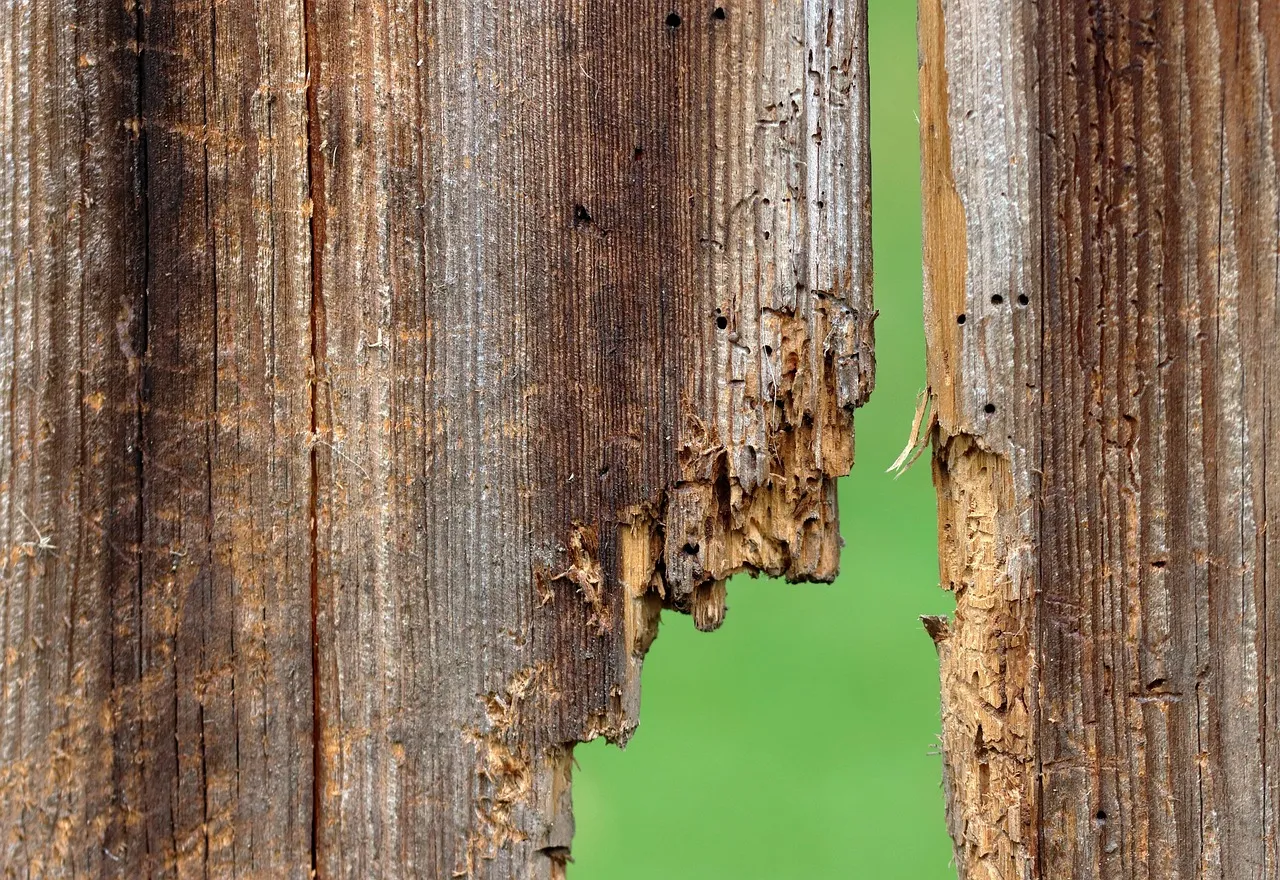
Small round holes and crumbling edges in old, weathered boards outdoors. The photo shows what such holes can look like; it is not a Queensland house, and what made these holes is not known. Photo by Emphyrio on Pixabay
The damage is not confined to new work. It may turn up wherever susceptible timber has been used: under the floor, in living areas, in the roof space, and in furniture and carved pieces.
Entry 3
The timber it eats, and the timber it leaves
The beetle needs three things from a piece of wood: sapwood of a susceptible hardwood, not a softwood; enough starch to feed its larvae; and pores large enough to take its eggs. Business Queensland gives the moisture content of the logs or sawn timber it attacks as 8 to 30 per cent.
Susceptible species named by Business Queensland
Kauri pine, spotted gums, western white gum, narrow-leaved red ironbark, Dunn’s white gum, rose gum, tallowwood, Sydney blue gum, European oak and kwila. The page draws these from Australian Standard AS 5604–2003 and the Queensland Government’s timber properties pages, and they are a selection, not the whole list.
Sapwood is the outer growth rings of a tree, and it is the weak part. WoodSolutions’ durability guide explains that natural durability ratings apply only to heartwood, that sapwood is not durable and is readily attacked unless treated, and that even a Class 1 hardwood, the most durable class, can fail early if a piece is mostly untreated sapwood. Treated timber, it adds, should carry a label or brand showing the treatment type, its hazard class and the certifier; the colour of the timber alone is no guarantee.
Entry 4
The beetle’s relatives
Business Queensland names a family of similar beetles beside the powderpost beetle, and Queensland’s Biosecurity Regulation lists two more timber borers among its prohibited matter.
A selection. The similar species are as named on Business Queensland’s powderpost beetle page; the legal status is from the Biosecurity Regulation 2016.
Beetle
What the source says
Small powderpost beetle (Lyctus discedens)
Up to 2 mm long.
Malayan powderpost beetle (Minthea rugicollis)
Now established in Queensland, having arrived in imported rainforest hardwoods from South-East Asia.
Common furniture beetle and Queensland pine beetle
Both named as similar species, as Anobium punctatum and Calymmaderus incisus.
European house borer (Hylotrupes bajulus)
Prohibited matter. Its carriers may not be moved into Queensland from a state where it has been found, unless an exception applies such as a biosecurity authorisation or certificate. Carriers are trees of the genera Abies, Picea, Pinus and Pseudotsuga, and wood or wooden articles from them; the regulation’s examples are furniture, pallets and sawn timber.
Drywood longicorn beetle (Stromatium barbatum)
Listed among the prohibited matter affecting plants, as is the powderpost beetle itself.
That last line has a practical edge. Business Queensland says powderpost beetle (Lyctus africanus) is prohibited matter under the Biosecurity Act 2014 and asks for suspected cases to be reported to Biosecurity Queensland immediately; its page gives the numbers to call.
Entry 5
Treat, coat or leave it
Business Queensland says prevention costs property owners less than treatment, and lists the ways to go about both.
Choose the timber. Remove the sapwood from susceptible species, or use timber that is not susceptible.
Seal every face. Paint, varnish or wax on all surfaces protects timber that is not yet infested, with no gaps left for a beetle to get in.
Kiln drying. It kills every stage of the beetle, but susceptible timber can be reinfested once it leaves the kiln.
Chemical treatment. Boron and other chemical treatments are available. Queensland Health lists the treatment of timber pests as one of the activities a pest management licence can authorise.
Leave it, and mend it. Where the damage is not structural, treatment may not be needed beyond repairing how the timber looks.
Borers also matter when a house changes hands. The timber pest inspection standard QBCC describes covers borers of seasoned timber along with subterranean termites and wood decay fungi. Tab 4 explains that inspection, and Tab 1 the licences behind the work.